
Empty Mornings, Overbooked Evenings: The Case for Mini Tennis in Malaysia
Malaysian courts are underused in the morning and overbooked by evening — and rain wipes out sessions on both. Here's why Mini Tennis fits the gap on all three fronts.
Two things are true about court time in Malaysia, and they sound like they contradict each other. Courts are hard to book. And courts sit empty.
Both are correct, just at different hours. Evening and weekend slots — roughly 7pm to 10pm on weekdays, most of Saturday and Sunday — fill fast enough that players routinely can't get in. Weekday mornings and early afternoons are the opposite problem: venues discount those hours by 30 to 50 percent just to get anyone through the door, according to pricing guidance from Courtsite, the Malaysian court-booking platform used by badminton, pickleball and padel venues nationwide. "Your morning crowd and your evening crowd are not the same," the company told venue operators in a July 2026 post. "Evening slots fill fast. Morning slots need a push."
That's the first win. A format that runs comfortably in a badminton hall or on a pickleball court, doesn't need the evening rush to be worthwhile, and can fill a Tuesday 11am slot a venue would otherwise discount or leave empty, is straightforward extra revenue on space that's already built and already staffed.
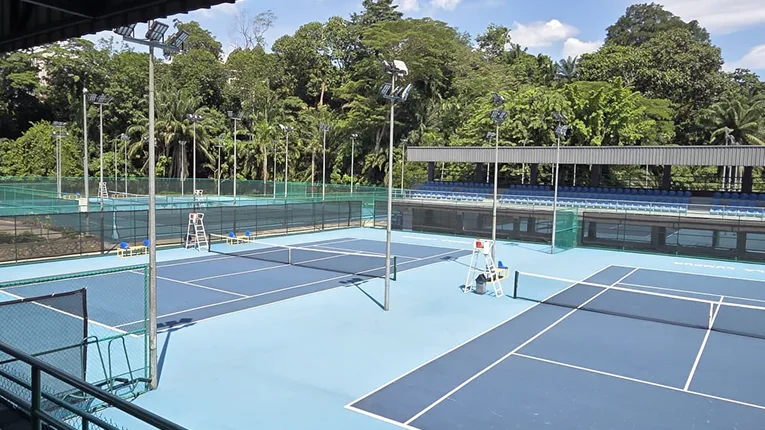
The second win is about what's actually using the scarce evening hours. A full-size tennis court is the default setup for every level of player, including someone in their first month of lessons who doesn't yet need 78 feet of court to learn a rally. That's not a criticism of how tennis is taught — it's just how court infrastructure works: there's one kind of court, so everyone uses it, whether the format in front of them needs it or not. Mini Tennis is built around a smaller footprint on purpose — a 21-inch racket and a 9cm foam ball that plays fine on a badminton court or pickleball court. Move beginner sessions there instead of onto a full tennis court, and the players who do need the full dimensions — the regulars fighting for a 7pm slot — get more of them back.
The third win shows up the moment it rains, which in Malaysia is often. Courtsite built an entire feature around this: Emergency Reschedule Request, launched earlier this year specifically because, in the company's words, "it starts with rain" — a customer checks the sky 30 minutes before their booking, sees dark clouds, and the WhatsApp back-and-forth begins. Courtsite's own documentation notes that during "widespread rain events," reschedule requests can arrive faster than venues can review them — evidence this isn't one venue's problem, it's a scheduling feature built for a systemic one.
Mini Tennis doesn't stop the rain. But because it doesn't need an outdoor tennis court — a badminton hall, a covered pickleball court, any indoor multi-purpose space works fine — a rained-out afternoon doesn't have to mean a cancelled session. The booking that would trigger an emergency reschedule outdoors can just continue indoors instead.
These aren't really three separate problems. They're the same one, seen from three different chairs — the venue operator with a quiet Tuesday morning, the regular player who can't get an evening slot, and the parent whose Saturday lesson gets rained out. In each case, the fix isn't more courts. It's matching the format to the space that's already there, instead of defaulting every player, at every level, onto the one format that needs the most of it.