For Every Tennis Player, Any Age

Start with thefoam ball

Foam ball, smaller court, real rackets. Everyone starts here  kids, adults, beginners. Works on pickleball court.

Powered byHEAD × Racketsports
01The Format

Where Mini Tennis comes from

Short Tennis in 1985, formalised by the ITF in 2001 — and still standard junior development across Europe.

41
years since 1985
  • Shrinking the equipment to speed up learning has a real history in European tennis. The UK's Lawn Tennis Association launched "Short Tennis" in 1985 — plastic rackets, sponge balls, a badminton-sized court.
  • It was recognised as an official development format by the sport's international governing body in 1990, then formalised by the ITF in 2001 into the red/orange/green progression used worldwide today.
  • Some accounts trace an earlier version to Sweden in the late 1970s under the same "mini tennis" name, though that thread is less well documented than the UK milestone.
  • From either starting point it spread across Europe through the 1980s and 90s, then globally — reaching China by the early 1990s.
  • Denmark is a strong, long-standing adopter rather than the documented country of origin: Dansk Tennis Forbund has run mini tennis as standard junior development for decades, and it remains a fixture in Danish clubs and school halls.
  • The constant across every version, wherever it's credited: shrink the equipment, slow the ball, get people rallying immediately — the same principle behind the 21-inch racket and 9 cm foam ball.
02Format Specs

What Mini Tennis is

Slow, low-bounce, and safe indoors.

HEAD 9cm foam ball

It is tennis — real rackets, real strokes, real tennis scoring — played with a 21-inch frame and a 9cm foam ball on a smaller court. Nothing about the game is simplified except the equipment, so everything you learn transfers straight to the full-size court.

Court
Pickleball
Net
Lowered
Ball
9cm foam (start)
Racket
21 inch
Ages
Any age
Format
Short sets
03How to Play

How to Play

Small court, lower net, foam ball, mini racket. That's it.

  1. 01Start on a small or pickleball court with a foam ball.
  2. 02Serve underarm or overarm.
  3. 03Score with standard or simplified tennis scoring.
  4. 04Progress through red, orange, green — then full tennis.

The Point System

Real tennis scoring from day one: 15 – 30 – 40 – Game. Or a quick format like first to 10 or a 7-point tiebreak.

It's tennis — just on a smaller stage.

04Why It Works

Why Minitennis?

Real tennis skills, without the frustration.

Faster success

Rally and score in your first session.
No tennis court needed

Fits on a pickleball court.

Truly for everyone

Any age, any level — same starting point.

Right-sized gear

Mini rackets and foam balls, matched to the player.

Builds real technique

Same footwork and grips as full tennis.

A clear pathway

Foam → Red → Orange → Green → full tennis.
From lesson one

Easier success, from lesson one

  • Removes the core mismatch: equipment sized to the player, not the other way around.
  • The 21-inch racket makes the contact point feel like an extension of the hand — the same shift that made pickleball approachable to first-timers.
  • The 9 cm foam ball travels at a fraction of tennis-ball speed, giving far more time to see the ball, move, and make clean contact.
  • Academic research on equipment modification confirms it: low-compression, slower balls consistently improve beginner control and technique.
  • The payoff is immediate — a real rally in lesson one, not lesson twenty, which is what actually keeps beginners coming back.
  • Mini Tennis fixes the real gap in tennis: full-size equipment versus a first-time player's ability to use it — the same fix that made pickleball work.
  • It works across every group with a reason to want an easier way in: beginners who quit before it clicks, time-poor adults, juniors learning to lose well, schools needing a safe deliverable format, and seniors wanting the game without the impact.
  • It fits neatly onto courts that already exist — quiet enough to share space with pickleball, small enough to answer a covered-court shortage tennis hasn't solved on its own.
05The Court Problem

You don't need a tennis court

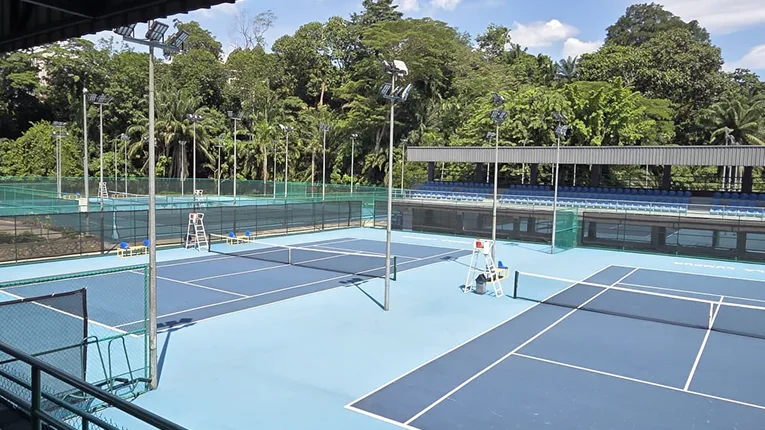
Courts are scarce. Mini Tennis is quiet and small enough to run on the courts that already exist.

  • Beginners are almost always taught on a full-size court, with a full-size 27-inch racket, hitting a pressurised yellow ball that behaves like a fastball to a first-timer.
  • The sweet spot sits at the end of a long lever, meeting a fast, spinning ball — a genuinely hard timing problem to solve early on.
  • Most adult beginners quit right before it clicks. A beginner after 20 sessions is often still a beginner after the 20th — not because they dislike tennis.
  • Pickleball solved this: a short, solid paddle and a slow, hollow ball put the hitting surface close enough to the hand to feel like an extension of the arm, collapsing the learning curve.
  • Mini Tennis applies the same logic to tennis — a 21-inch racket and a 9 cm foam ball. Not a different sport, a fix to the same one.
  • It mirrors the ITF's own Play and Stay / Tennis 10s progression (red, orange, green balls), already shown to improve beginner control, technique and retention. Mini Tennis goes one step further by shrinking the racket too.
  • Market fit: tennis faces a global shortage of roughly 180,000 courts, and covered courts are especially scarce — the UK has around 1,600 indoor courts against France's 9,000-plus.
  • Pickleball court growth has slowed sharply through 2025–2026 as supply caught up with demand, leaving some venues looking to fill courts rather than build more.
  • Because the foam ball is near-silent, Mini Tennis can be played on a live pickleball court without disturbing the match next to it — giving tennis access to covered courts it lacks, and venues more use from courts they already built.
06The Pathway

Foam, red, orange, green — then full tennis

Every stage keeps the same game and steps the ball and court up one notch.

01

Red Stage

Mini court, focus on rallying.

02

Orange Stage

Bigger court, faster ball.

03

Green Stage

Near full court, ready for tennis.

No Court? No Problem.

Fits on a pickleball court too.

HEAD starter equipment

Every session runs on HEAD gear: a 21-inch junior frame and the 9cm foam ball. Coaches provide equipment to begin with — Racketsports stocks the full range when you're ready.

07The Racket Range

HEAD 21″ frames

HEAD 21-inch frames share the same length. Any of them works for a first racket.

Each is paired with the HEAD 9cm foam ball.

08Questions

Frequently Asked

10Next Step

Find a Coach

Certified Minitennis coaches are listed on the national Tennis Coach Malaysia directory.

Are you a coach? Get certified and listed →