For Tennis Players

A real format,not a gimmick

Mini Tennis is short-court tennis with governing-body pedigree — quick, social, low impact, and playable on courts you can actually book. Same shot-making, less wear.

01The Format

Where Mini Tennis comes from

Short Tennis in 1985, formalised by the ITF in 2001 — and still standard junior development across Europe.

41
years since 1985
  • Shrinking the equipment to speed up learning has a real history in European tennis. The UK's Lawn Tennis Association launched "Short Tennis" in 1985 — plastic rackets, sponge balls, a badminton-sized court.
  • It was recognised as an official development format by the sport's international governing body in 1990, then formalised by the ITF in 2001 into the red/orange/green progression used worldwide today.
  • Some accounts trace an earlier version to Sweden in the late 1970s under the same "mini tennis" name, though that thread is less well documented than the UK milestone.
  • From either starting point it spread across Europe through the 1980s and 90s, then globally — reaching China by the early 1990s.
  • Denmark is a strong, long-standing adopter rather than the documented country of origin: Dansk Tennis Forbund has run mini tennis as standard junior development for decades, and it remains a fixture in Danish clubs and school halls.
  • The constant across every version, wherever it's credited: shrink the equipment, slow the ball, get people rallying immediately — the same principle behind the 21-inch racket and 9 cm foam ball.
02Format Specs

The numbers

Everything that differs from full-size tennis, in one place.

Court
Pickleball
Net
Lowered
Ball
9cm foam (start)
Racket
21 inch
Ages
Any age
Format
Short sets
03How to Play

How to Play

Same rules, shorter court, faster setup.

  1. 01Start on a pickleball court or half a tennis court with a foam or soft ball — no full tennis-court booking required.
  2. 02Serve underarm or overarm, whichever gets a rally going faster.
  3. 03Score with standard scoring, or a quick format — first to 10, or a 7-point tiebreak — when you've only got a short window.
  4. 04Step up the ball (foam → red → orange → green), or go straight to a regular ball with the social format if you just want a hit.

Point System

Standard tennis scoring: 15–30–40–Game. Or a quick format like first to 10 or a 7-point tiebreak — built for a court you booked for an hour, not an afternoon.

04Why It Works

A good addition to how you already play

Near-silent, quick to set up, and easy on the joints — an add-on session rather than a replacement.

Adults

An early "I can do this" moment, on a court quiet enough to share with pickleball.

  • Adults are the group tennis loses fastest — they evaluate within a few sessions whether it's worth their time.
  • An early "I can do this" moment, from a manageable court and a forgiving ball, is a much easier sell than a format asking for faith over 20 sessions.
  • Near-silent play means Mini Tennis can run on a pickleball court next to a live match — an easy add-on for venues with quiet off-peak court time.
  • Gives adult players and coaches a usable court option in markets where covered tennis courts are in short supply.
  • Lower setup, lower time cost, more immediate enjoyment — it respects a time-poor adult's investment in lessons.
Playing longer

The same game at a gentler pace — a practical way back into tennis.

  • A genuinely slower version of the same game, not a different sport — keeps the shot-making without the running, sprinting and hard direction changes.
  • The foam ball gives far more reaction time, so rallies stay controlled rather than turning into a scramble.
  • Matches the lower-impact logic already drawing older adults to paddle sports: smaller courts, slower pace, less strain on hips and knees.
  • A practical re-entry point for anyone who stepped back from full-size tennis for fitness, joint or confidence reasons — without giving up the sport.
  • Cheap and low-logistics to keep playing socially: no club membership needed, just a court, racket sets and foam balls on courts that already exist.
05The Court Problem

Getting court time is the actual bottleneck

Mini Tennis runs on courts you can already book.

  • Tennis faces a global shortage of roughly 180,000 courts, and covered courts are especially scarce — the UK has around 1,600 indoor courts against France's 9,000-plus.
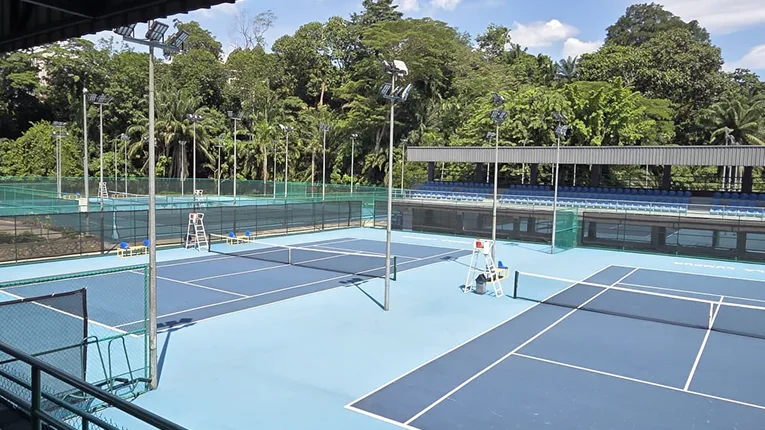
  • In Malaysia, pickleball's rapid growth has converted a chunk of existing tennis court capacity, and monsoon rain cuts into outdoor hours on top of that.
  • Because the foam ball is near-silent, Mini Tennis can be played on a live pickleball court without disturbing the match next to it — it doesn't need a dedicated tennis booking to happen.
  • That means a short match or hitting session can happen on whatever court is free, rather than waiting for a tennis-specific slot during peak hours.
  • It's not a replacement for full-size tennis — it's a way to keep playing when the court you'd normally use is booked out.
06The Pathway

Where this fits if you already play

Two ways in — the graded pathway, or the drop-in social format.

  • The foam → red → orange → green progression is the same one used in junior development worldwide — useful as a coaching or warm-up reference even if you're well past it.
  • For a straight social hit, skip the graded balls: Mini Tennis's social format uses a bigger, slower 12cm foam ball with your own regular racket, no junior frame needed.
  • Either version is lower-impact than a full-speed rally — useful for keeping playing through an injury, a long layoff, or just a shorter session between full games.
07The Racket Range

HEAD 21 mini tennis rackets

HEAD 21-inch frames — the right size for a Minitennis start.

Paired with the HEAD 9cm foam ball — the low-bounce companion for every 21″ racket above.

08Questions

Questions from players

10Next Step

Find a Coach

Certified Minitennis coaches are listed on the national Tennis Coach Malaysia directory.

Are you a coach? Get certified and listed →